

Description
Microsoft Windows Server 2025 Standard OEM Package is a reliable, enterprise-grade server operating system solution delivered through genuine OEM licensing, specifically designed for small and medium-sized businesses (SMBs) and growing organizations that need robust performance, advanced security, and flexible hybrid cloud capabilities. As an OEM-exclusive package, it is permanently tied to the physical server it is first installed on, offering a cost-effective, pre-integrated solution that simplifies deployment and ensures full compliance with Microsoft’s licensing standards, while leveraging the latest innovations of the 2025 edition.
Package Inclusions
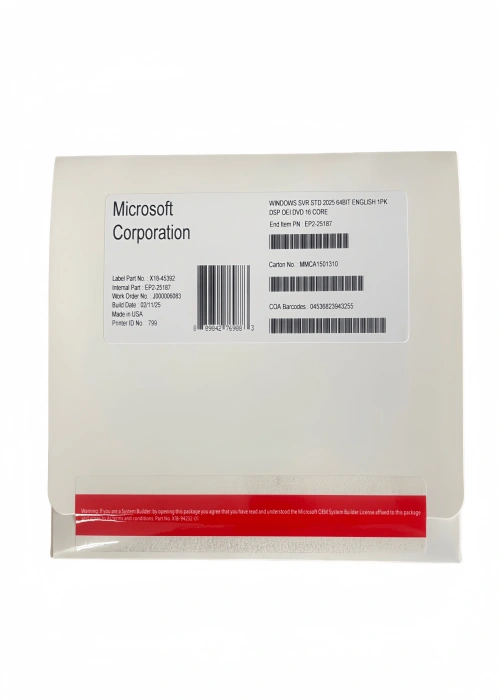
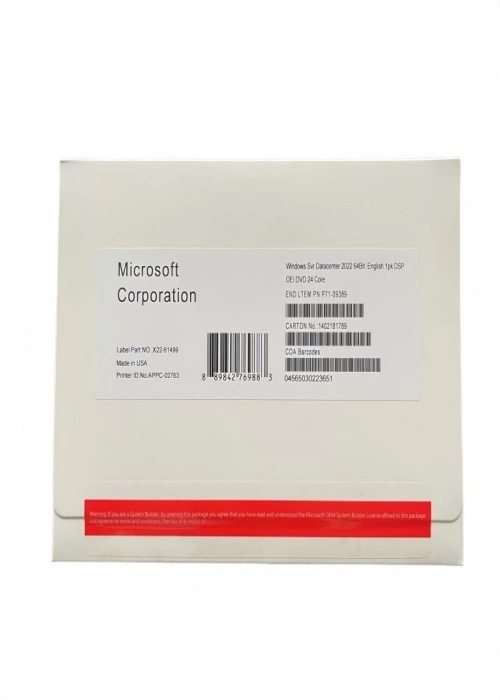
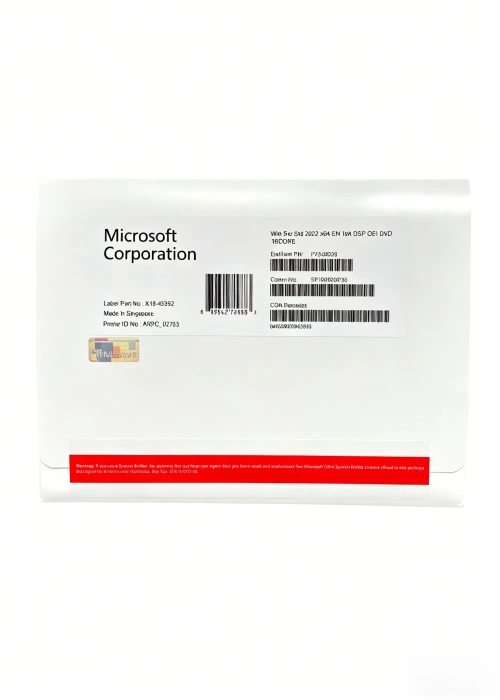
Each Windows Server 2025 Standard OEM Package comes complete with all essential components for seamless setup and immediate operation: a genuine core-based Windows Server 2025 Standard license (typically 16-core configuration, scalable for additional cores as needed), installation media (DVD), an authentic product key for online activation, a Certificate of Authenticity (COA) to verify genuine Microsoft software, and basic deployment guidelines to help IT teams quickly configure the server for their specific workloads and business needs.
Key Features & Advantages
Built on Microsoft’s legacy of innovation, Windows Server 2025 Standard OEM Package delivers enhanced capabilities tailored to modern SMBs. It supports up to 2 virtual machines (VMs) per license, making it ideal for organizations with moderate virtualization needs, along with improved performance features including NVMe storage acceleration and support for up to 4 PB of RAM and 2,048 logical processors—far exceeding the capabilities of previous versions. The OS also features a refreshed, Windows 11-aligned interface for better usability, along with native DTrace tooling for real-time performance monitoring and troubleshooting.
Security is a core focus, with expanded Secured-Core Server technology that integrates hardware, firmware, and OS-level protections, including TPM 2.0 support, credential guard, and hypervisor-protected code integrity (HVCI) to block advanced malware. Additional security enhancements include TLS 1.3 by default, AES-256 encryption for data in transit and at rest, SMB over QUIC, and over 350 preconfigured security settings to fortify defenses against evolving cyber threats, while also strengthening Active Directory with improved encryption and protocol hardening.
Seamless hybrid cloud integration is a standout feature, with Azure Arc preinstalled for centralized management of on-premises, multi-cloud, and edge environments, along with hotpatching for seamless updates without downtime. Windows Admin Center provides an intuitive browser-based interface to streamline server administration, while the improved storage migration service enables low-latency data migration to Azure, minimizing on-premises storage needs. The OS also supports GPU partitioning for AI and machine learning workloads, along with enhanced Windows containers that reduce image sizes and improve compatibility with Kubernetes.
System Requirements
To ensure optimal performance, the Windows Server 2025 Standard OEM Package requires the following minimum hardware specifications: a 1.4 GHz 64-bit processor compatible with the x64 instruction set (supporting NX, DEP, EPT/NPT, and SSE4.2), 2 GB of RAM for Server Core (4 GB recommended for Server with Desktop Experience), 32 GB of minimum available disk space, a Gigabit Ethernet adapter, and UEFI 2.3.1c with Secure Boot capability (TPM 2.0 is required for Secured-Core features). ECC memory is recommended for physical host deployments to ensure stability.
Ideal For
This OEM package is perfectly suited for small and medium-sized businesses (SMBs), growing organizations, and departments within larger enterprises that require reliable server performance, moderate virtualization, and enterprise-grade security without the full feature set of the Datacenter edition. It is particularly ideal for businesses deploying new physical servers and seeking a genuine, pre-licensed solution that aligns with their IT infrastructure needs, supporting critical workloads such as Active Directory, file and print services, web apps, and line-of-business applications.
Reviews
There are no reviews yet.